 Daysafe
183-Day Rule Calculator
Many countries treat you as a tax resident once you spend 183 days there — but they count differently: by calendar year, by tax year or over any 12 months. The U.S. uses a weighted three-year formula instead. Enter your stays, choose how your country counts, and see where you stand.
The calculator needs JavaScript.
How countries count 183 days
| Country | Rule | Set the calculator to |
|---|---|---|
| Spain | More than 183 days in the calendar year. Short trips abroad still count as days in Spain unless you prove tax residence in another country. | Calendar year · any part of the day · 184 |
| United Kingdom | 183 days or more in the tax year (6 April – 5 April) makes you automatically resident. A day counts if you are in the UK at midnight. | Tax year from 6 April · at midnight · 183 |
| United States (federal tax) | Not a flat 183 days. The substantial presence test needs at least 31 days this year and 183 over three years: all days this year, 1/3 of last year's and 1/6 of the year before. 120 days in each of three years gives 120 + 40 + 20 = 180, so the test isn't met. States have their own rules. | Substantial presence test calculator |
| Russia | At least 183 days within 12 consecutive months. | Any 12 months in a row · any part of the day · 183 |
Other countries have their own versions — check the rule of the country you're counting for. If you're an American living abroad, the U.S. still taxes you wherever you are; the day count that matters there is 330 full days abroad, covered in digital nomad taxes.
183 days is rarely the only test
Many countries also look at where your home is, where your family lives and where your income comes from — you can be resident with fewer days. If two countries both treat you as resident, a tax treaty between them usually decides. In the UK the 183-day test is one part of the Statutory Residence Test; in the U.S. the federal rule is the substantial presence test.
183 days in U.S. states
States set their own residency tests, and a state can make you a resident even when the federal test doesn't. The day rules differ in wording, so read your state's own law. Three examples from the statutes:
| State | Resident by days if you… | Source |
|---|---|---|
| New York | keep a permanent place of abode in the state and spend more than 183 days of the tax year there — whether or not New York is your domicile | N.Y. Tax Law §605(b)(1)(B) |
| Minnesota | keep a place of abode in the state and spend more than half of the tax year there. Any part of a calendar day counts as a day, and you must keep records of days spent outside | Minn. Stat. §290.01, subd. 7 |
| California | are in the state for other than a temporary or transitory purpose. There is no 183-day count; you are presumed a resident if you spend more than nine months there in a tax year | Franchise Tax Board, Publication 1031 |
New York's tax department writes its rule as "184 days or more" and adds that "any part of a day is a day," so a dinner in Manhattan counts. If you keep a home there, you have to prove your count: see New York residency audit. Leaving California has its own traps, covered in California exit tax. States without a personal income tax, such as Florida, have no reason to count your days; what matters is the count in the state you left, as explained in how to become a Florida resident.
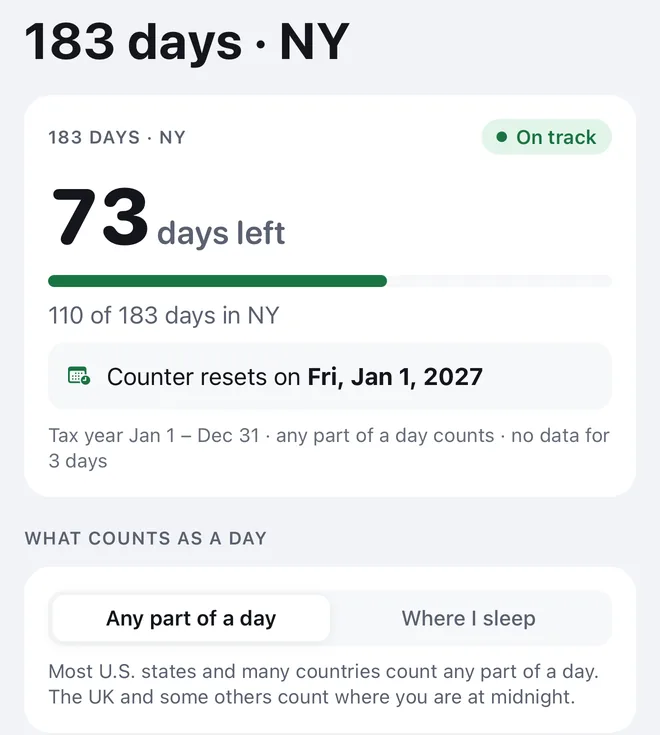
"More than 183 days" means 184 or more. In New York and Minnesota the day test applies only if you also keep a home in the state; if the state is your domicile, you are a resident there anyway.
Can you be a resident of two states?
Yes. One state can treat you as a resident because it is your domicile, while another treats you as a statutory resident because you kept a home there and passed its day count. New York's rule, for example, applies "whether or not domiciled" in the state. How the double taxation is then relieved depends on the two states' rules — check with both tax agencies or a tax adviser. The full rules, state by state, are in Can you be a resident of two states?
How many months is 183 days?
About six months, but not exactly. Counting 1 January as day 1, day 183 of 2026 is 2 July; 1 January to 30 June is only 181 days. A stay from 1 July to 31 December 2026 is 184 days — enough for a "more than 183 days" test. Because months have 28 to 31 days, count the days themselves, not months. To find the date 183 days after a given day, use 183 days from today.
Common day-counting mistakes
- Not counting partial days. New York and Minnesota count any part of a day as a day: a flight that lands at 11 p.m. or a dinner across the state line is a full day. The UK instead counts the days you are there at midnight.
- Measuring the wrong period. Spain and U.S. states count the calendar year, the UK the tax year from 6 April, Russia any 12 months in a row. 183 days "this year" can mean three different windows.
- Reading 183 as 184, or the other way round. "More than 183 days" (Spain, New York) is met on day 184; "183 days or more" (UK) on day 183.
- Trusting passport stamps. They show border crossings, not where you slept. Travel between U.S. states, or between Schengen countries, usually leaves no stamp at all.
- Counting by feel. "About six months" is not a count. Six calendar months can be 181 to 184 days.
How to prove your day count
When a tax authority checks residency, you usually carry the burden of proof. New York's audit guidelines, for example, let auditors ask for a diary or calendar of where you were each day, credit card statements, phone bills, flight and hotel records and E-ZPass logs, and they compare them. A record kept during the year, which agrees with those documents, carries the most weight; a log rebuilt from memory during the audit is weaker. More in New York residency audit.
The 183-day rule in tax treaties
Many tax treaties follow Article 15 of the OECD Model Tax Convention for salaries. If you live in one country and work for a while in another, your salary is taxed only in your home country when all three conditions hold:
- you are in the other country for no more than 183 days in any 12-month period that starts or ends in the tax year;
- your employer is not a resident of the other country;
- the salary isn't paid through your employer's permanent establishment in the other country.
This is the model text; each treaty words it its own way, so check the treaty between your two countries. It decides where a salary is taxed, not whether you are a resident.
Questions
Does the 183-day rule apply to U.S. taxes?
Not as a flat limit. For federal taxes the U.S. uses the substantial presence test: at least 31 days this year and 183 weighted days over three years. States have their own residency rules — see 183 days in U.S. states above.
Do the 183 days have to be consecutive?
No. The days are added up over the period — several shorter stays count together.
Do the days I arrive and leave count?
It depends on the country. Many count any part of a day; the UK counts only days when you are in the country at midnight. Choose the option in the calculator.
Is 183 days the same as six months?
Not exactly. Six calendar months can be 181 to 184 days, so count days, not months. Counting from 1 January, day 183 is 2 July — or 1 July in a leap year.
Can I be a tax resident in two countries?
Yes. Each country applies its own rules. A tax treaty between the two countries usually has tie-breaker rules — permanent home first, then centre of vital interests.
What period does "any 12 months" mean?
Any 12 consecutive months, not tied to the calendar year. The calculator looks back 365 days from the date you check.
Is this tax advice?
No. It counts days. Whether you are tax resident depends on more than days — for your situation, ask a tax adviser.
Let your iPhone count the days
Daysafe records which country you're in each day and keeps your 183-day count for every country up to date, with the date you'd reach the limit. No account; your days stay on your phone.
Get Daysafe on the App Store · Schengen calculator · ESTA 90-day calculator
Sources
Spain: Ley 35/2006 del IRPF, art. 9.1.a — BOE. UK: GOV.UK, Tax on foreign income: residence; HMRC, Residence and FIG Regime Manual. U.S. states: N.Y. Tax Law §605 — NY Senate, and Department of Taxation and Finance, income tax definitions and Nonresident Audit Guidelines (records auditors request); Minn. Stat. §290.01 — Revisor of Statutes; California — Franchise Tax Board. Treaties: OECD Model Tax Convention, art. 15. Russia: Tax Code, art. 207(2) — ConsultantPlus. Checked on 13 October 2026; New York and California rechecked on 25 November 2026. Daysafe is a day counter, not tax advice. Made by Denis Chudinov.