 Daysafe
Spain 183-Day Rule Calculator
You are a tax resident of Spain if you spend more than 183 days there in a calendar year — so the 184th day is the one that matters. Short trips abroad can still count as days in Spain unless you prove tax residence in another country. Enter your stays to see where you stand this year.
The calculator needs JavaScript.
How Spain decides you are a tax resident
Under the Spanish income tax law (Ley 35/2006, art. 9.1) you are resident if any one of these applies:
- More than 183 days in Spain in the calendar year (1 January – 31 December). Sporadic absences are counted as days in Spain unless you prove tax residence in another country. For countries treated as tax havens (now called non-cooperative jurisdictions), the tax office can ask you to prove 183 days there.
- Your main centre of business or economic interests is in Spain, directly or indirectly — even with fewer days.
- Family presumption: if your spouse (not legally separated) and your dependent minor children live in Spain, you are presumed resident unless you prove otherwise.
The calculator counts the first test — days. It is already set for Spain: calendar year, any part of a day, 184 days.
What "sporadic absences" means for your count
If you live in Spain and leave for short trips, those days still count as days in Spain unless you have a tax residence certificate from another country. Without such a certificate, enter your whole stay in Spain without cutting out the short trips. With one, enter only the days you were in Spain.
How Spain counts a day
Spain's central tax tribunal (TEAC, resolution of 25 April 2023) set out the method: any day you are present counts in full, with no minimum number of hours. The total is built in three steps:
- Certified presence — days you can prove you were in Spain, each counted as a whole day.
- Presumed days — days that fall between two certified days in Spain count too, unless you prove you were abroad.
- Sporadic absences — short trips abroad are added on top, unless you hold a tax residence certificate from another country.
A stay from 1 July to 31 December is 184 days, so it makes you resident for that calendar year. From 2 July to 31 December is 183 days — not more than 183.
Example: a freelancer's year, with and without a certificate
You arrive in Spain on 15 February 2026 and leave on 31 August — 198 days. In between you fly home twice: 1–20 May and 1–7 July. The days you leave and return still count as days in Spain, so 18 days in May and 5 in July are spent fully abroad.
| Your situation | Days counted for Spain | Result for 2026 |
|---|---|---|
| No tax residence certificate from another country | 198 — the two trips are sporadic absences and count | Resident by days; the 184th day is 17 August |
| Certificate of tax residence in another country | 175 — only the days you were in Spain | Not resident by days (the other two tests can still apply) |
To check a year like this, enter your stays in the calculator above: without a certificate as one stay from arrival to departure, with a certificate as separate stays between your trips.
Resident for the whole year, not part of it
Spain's tax year is the calendar year, and the tax office's guide for non-residents says you are resident or non-resident for the whole calendar year: changing residence doesn't split the year. If you pass 183 days by August, you are resident for all of 2026.
What changes when you are resident
- Income tax on worldwide income. Spanish income tax (IRPF) covers all your income and gains, wherever they arise and wherever the payer is (Ley 35/2006, art. 2).
- Foreign assets return (Modelo 720). Residents must report certain assets held abroad. After the first return, a new one is due when a block of assets grows by more than €20,000.
- Special regime for people moving to Spain ("Beckham law"). If you weren't resident in Spain in the previous five tax years and move for qualifying work, you can opt for a flat rate: 24% on employment income up to €600,000 and 47% above, for the year of the move and the next five years (Ley 35/2006, art. 93). You opt in with Modelo 149 and file with Modelo 151. Employees with Spain's international teleworking visa qualify.
Tax residence certificates
Spain's tax agency (AEAT) issues a certificate of Spanish tax residence when its records show you are resident. You can request it online in the Sede electrónica with Cl@ve or a digital certificate, or at your local AEAT office with Modelo 01. A certificate from another country is what stops your short trips abroad from counting as days in Spain.
If two countries claim you
A tax treaty decides. The treaty between Spain and the United States, like most treaties, checks these in order and stops at the first one that settles it:
- Where you have a permanent home available to you.
- If you have one in both countries: where your personal and economic ties are closer — your centre of vital interests.
- Where you habitually live.
- Your nationality.
- Otherwise, the two tax authorities agree between themselves.
US citizens living in Spain still file US returns, whatever Spain decides: see digital nomad taxes and the bona fide residence test.
Treaties differ in wording, so check the one between Spain and your country.
Tax residence is separate from the visa rule. If you are a visitor, the 90/180 limit decides how long you may stay: UK citizens in Spain · US citizens in Spain.
Questions
Is the Spanish rule 183 or 184 days?
More than 183 days, so you become resident on the 184th day in Spain within the calendar year.
Do the days have to be consecutive?
No. All days in Spain during the calendar year are added up.
Does a Spanish residence permit make me a tax resident?
Not by itself. Residence permits and tax residence are different things: tax residence follows the tests above — days, economic interests and family.
What if another country also treats me as resident?
A tax treaty between Spain and that country usually decides, looking first at where you have a permanent home and then at your centre of vital interests.
Is this tax advice?
No. It counts days. For your situation, ask a tax adviser in Spain.
Let your iPhone count the days
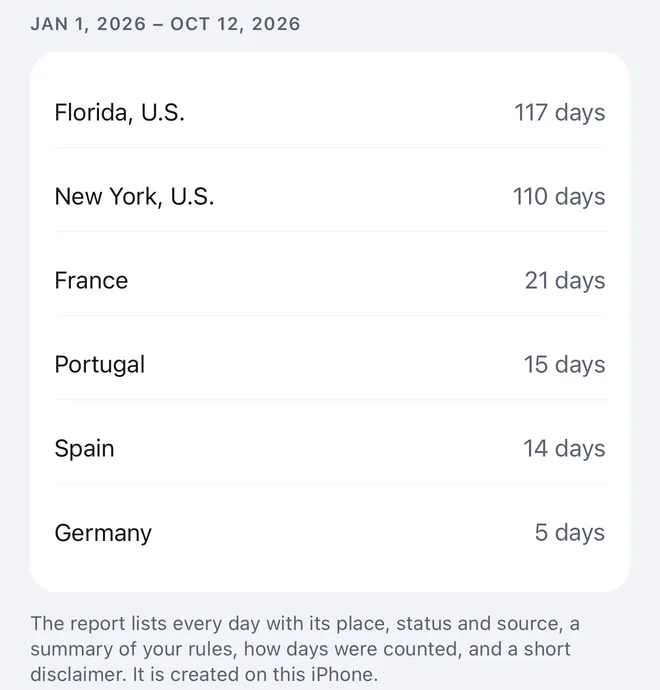
Daysafe records which country you're in each day and keeps your Spain count up to date — with the date you'd reach the limit. No account; your days stay on your phone.
Get Daysafe on the App Store · 183-day rule calculator for any country
Sources
Ley 35/2006 del IRPF, arts. 2, 9, 12 and 93 — BOE; TEAC, resolution 00/04812/2020 of 25 April 2023 — DYCTEA; AEAT — tax residence certificates, special regime; Spain–US tax treaty, art. 4 — BOE. Checked on 13 October 2026. Daysafe is a day counter, not tax advice. Made by Denis Chudinov.