 Daysafe
Bona Fide Residence Test
The bona fide residence test is one of two ways to qualify for the Foreign Earned Income Exclusion (up to $132,900 for 2026). You pass it if you are a bona fide resident of a foreign country for an uninterrupted period that includes an entire tax year, January 1 to December 31. It doesn't count days. It asks whether you made your home abroad, and the IRS decides from what you report on Form 2555.
Counting days instead? The other route is the physical presence test: 330 full days abroad in 12 months. Check it with the FEIE physical presence calculator.
Bona fide residence test requirements
To pass, all of these must be true:
- You can use the test. It's open to U.S. citizens, and to U.S. resident aliens who are citizens or nationals of a country with a U.S. income tax treaty in effect.
- Your tax home is in a foreign country. This applies to both FEIE tests: your main place of work is abroad.
- You are a resident there, not a visitor. You went for an indefinite or extended stay and set up your home there. The IRS says you "do not automatically acquire bona fide resident status merely by living in a foreign country" for a year.
- The period covers a full tax year. For calendar-year filers that means January 1 through December 31, without a break in your residence.
- You haven't told that country you're a nonresident. If you gave its tax authorities a statement that you're not a resident and they treat you as not subject to their income tax as a resident, you aren't a bona fide resident there.
How the IRS decides
There is no list of boxes that guarantees a pass. The Form 2555 instructions put it this way: evidence of your intention "may be your words and acts. If these conflict, your acts carry more weight than your words." Going abroad "for a definite, temporary purpose" and coming back when it's done doesn't make you a resident. An open-ended job and a household abroad point the other way.
The IRS can't rule on your status until you file. Part II of Form 2555 is where you make the case:
| Line | What it asks | What it shows |
|---|---|---|
| 10 | Date your bona fide residence began and ended | Your qualifying period |
| 11 | Living quarters: purchased house, rented home or room, or employer housing | How settled you are |
| 12 | Whether family lived with you abroad, and when | Where your household is |
| 13 | Whether you told the foreign country you're not a resident, and whether you must pay its income tax | "Yes" to the first and "No" to the second disqualifies you |
| 14 | Each date you arrived in and left the U.S., days in the U.S. on business, and U.S. income | Your time back home |
| 15 | Contract terms on the length of your job abroad, your visa, and whether it limits your stay | Whether the stay was temporary |
Line 14 is the one people reconstruct in April from old boarding passes. Every trip to the U.S. needs an arrival and departure date.
Trips home don't break the period
You can leave your foreign country "for brief or temporary trips back to the United States or elsewhere" for vacation or business. What keeps your status is a clear intention to return "without unreasonable delay" to your foreign home, or to a new one in another foreign country. A move back to the U.S. ends the period; a two-week visit for the holidays doesn't.
The test has no day limit for those trips, but the days still matter: long or frequent stays in the U.S. weaken the case that your home is abroad, and line 14 asks for each one.
Bona fide residence vs. physical presence test
| Bona fide residence | Physical presence | |
|---|---|---|
| Who can use it | U.S. citizens; resident aliens from treaty countries | U.S. citizens and resident aliens |
| What counts | Your home and intention | Days only: 330 full days abroad |
| Period | Uninterrupted, including a full tax year | Any 12 consecutive months |
| Trips to the U.S. | Allowed if brief and you intend to return | Each one costs full days; about 35 days of slack in 12 months |
| Fastest after a move | After your first full calendar year abroad | After 12 months |
| Form 2555 | Part II | Part III |
| Law | 26 U.S.C. §911(d)(1)(A) | 26 U.S.C. §911(d)(1)(B) |
You complete one part of Form 2555, not both. For physical presence, a "full day" is the 24 hours from midnight, so travel days don't count. The physical presence calculator counts them for you.
What passing the test gets you
Bona fide residence qualifies you for three benefits on Form 2555:
- Foreign earned income exclusion: up to $132,900 of foreign wages or self-employment income for 2026, prorated by day for a partial year.
- Foreign housing exclusion (for employees) or housing deduction (for the self-employed): housing costs above a base amount of 16% of the maximum exclusion, which is $21,264 for 2026.
- The housing costs you can count are capped, generally at 30% of the maximum exclusion ($39,870 for 2026), with higher limits for expensive cities.
The exclusion covers earned income only. Investment income, such as interest and dividends, isn't earned income and stays taxable, and you can't also take a foreign tax credit on income you excluded.
Your first year abroad
The full calendar year can come after your move, so the first year is usually the hard one. Example: Sam moves to Lisbon on 1 March 2026 for a job with no end date.
- Bona fide residence: Sam's first full tax year abroad is 2027. On 1 January 2028 the test is met, and Sam's bona fide residence counts from 1 March 2026.
- Physical presence: if Sam's first full day abroad is 2 March 2026, the 12 months end on 1 March 2027. Sam passes with 330 full days abroad in that window: about 35 days of slack for trips and travel days.
- Filing for 2026: Sam can ask for more time with Form 2350, filed by the return's due date, or file without the exclusion and amend after qualifying.
Once the test is met, it reaches back. The IRS says you qualify "starting with the date you began the residency and ending with the date you abandon your foreign residence," which can cover parts of one or two other tax years.
Records to keep
- your lease or deed, and utility bills in your name abroad;
- your residence permit or visa, and any employment contract;
- foreign tax returns or proof you pay income tax there;
- where your spouse and children live and go to school;
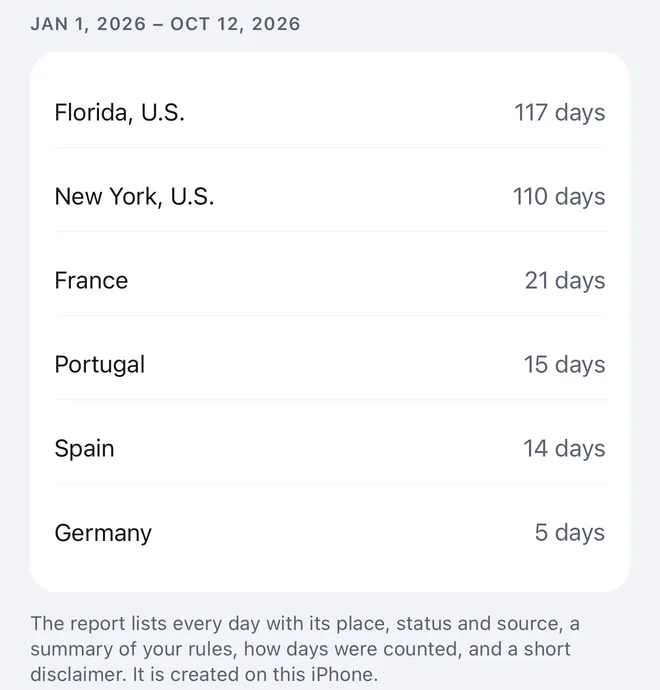
- a day-by-day record of where you were, with each U.S. arrival and departure.
The last one is what line 14 asks for, and what the physical presence test runs on. A record kept as you go beats one rebuilt from memory: see how Daysafe records each day.
Questions
What is the bona fide residence test?
It's an IRS test for the Foreign Earned Income Exclusion. You pass if you're a bona fide resident of a foreign country for an uninterrupted period that includes a full tax year, with your tax home abroad. It looks at your home and intention, not a day count.
How long do you have to live abroad to be a bona fide resident?
Long enough to cover one entire tax year, January 1 to December 31, without breaking your residence. A year abroad that runs from March to March doesn't qualify, because it covers no full calendar year.
Can green card holders use the bona fide residence test?
Only if they are citizens or nationals of a country with a U.S. income tax treaty in effect. Other resident aliens can use the physical presence test.
Can I visit the U.S. during my bona fide residence?
Yes. Brief or temporary trips are allowed if you clearly intend to return to your foreign home without unreasonable delay. List each trip on line 14 of Form 2555.
Does a job with a fixed end date qualify?
Usually not. The IRS says that if you go abroad to work for a specified period, you ordinarily aren't a bona fide resident, even if you work there a year or longer. The physical presence test may still work.
Which test should I use?
If you'll spend at least 330 full days abroad in 12 months, physical presence is simpler to prove. Bona fide residence helps people who travel to the U.S. often but live abroad. Ask a tax adviser who works with expats.
Is this tax advice?
No. Daysafe counts days and shows rules with their sources. For your return, talk to a tax adviser.
Keep the dates Form 2555 asks for
Daysafe records which country you're in each day, counts full days abroad for the physical presence test, and exports a day-by-day PDF or CSV with every U.S. arrival and departure. No account; your days stay on your phone.
Get Daysafe on the App Store · FEIE physical presence calculator
Sources
IRS, Foreign earned income exclusion — bona fide residence test; IRS, Instructions for Form 2555 (2026 exclusion amount, Part II, full day) and Form 2555; IRS Publication 54 (Form 2350 extension); 26 U.S.C. §911(d)(1); 26 CFR §1.911-2. Checked on 25 November 2026.