 Daysafe
FEIE Physical Presence Test Calculator
To claim the Foreign Earned Income Exclusion under the physical presence test, you need 330 full days in foreign countries during any 12 consecutive months. Enter the day you left the U.S. and your trips back — the calculator counts your full days abroad and finds your first qualifying 12-month period.
The calculator needs JavaScript.
What is the physical presence test?
It's one of two ways for U.S. citizens and resident aliens working abroad to qualify for the Foreign Earned Income Exclusion (Form 2555). You meet it if you are physically present in a foreign country or countries for at least 330 full days during any period of 12 consecutive months. The days don't have to be in a row, and it doesn't matter why you were abroad.
How a "full day" is counted
- A full day is 24 hours, from midnight to midnight, spent in a foreign country.
- The day you leave the U.S. and the day you come back don't count — part of them is spent in the U.S. or in the air.
- Time on or over international waters doesn't count. An overnight flight can cost you the arrival day too.
- The U.S. and its territories (Puerto Rico, Guam, the U.S. Virgin Islands and others) are not foreign countries.
- A U.S. layover of less than 24 hours between two foreign points doesn't count as presence in the U.S.
- Moving between foreign countries doesn't cost full days, but travel that is not within foreign countries and takes 24 hours or more does.
- Days spent in a country in violation of U.S. law don't count.
The 35-day budget
A 12-month period has 365 days (366 if it includes 29 February). With 330 full days needed, you have about 35 days for U.S. visits and travel days combined. Every trip home costs at least two days: the day you fly in and the day you fly out.
Choosing your 12-month period
The period can start on any day — it doesn't have to match the calendar year — and it ends the day before the same date 12 months later. In your first and last years abroad you can pick the period that gives you the most days, and periods for different years can overlap. The calculator finds the first period that qualifies; change "Check on" to test any other.
What passing the test gets you
Passing makes you eligible for the Foreign Earned Income Exclusion on Form 2555: for 2026, up to $132,900 of foreign wages or self-employment income. The test only opens the door; your tax home also has to be abroad, and investment income isn't covered.
In your first and last year abroad the maximum is cut by days. Form 2555 takes the number of days in your qualifying period that fall within the tax year, divides it by the days in the year and multiplies $132,900 by the result.
| Example: 12-month period 1 March 2026 – 28 February 2027 | |
|---|---|
| Days of the period in 2026 (1 March – 31 December) | 306 |
| Share of the year: 306 ÷ 365 | 0.838 |
| Maximum exclusion for 2026: 0.838 × $132,900 | $111,370 |
The 2027 return then uses a second period, which may overlap the first.
How you claim it: Form 2555, Part III
- Part III is for the physical presence test. You fill in either Part II (bona fide residence) or Part III, not both.
- Line 16 asks for the dates of your 12-month period. It must include 365 days (366 in a leap year), and part of it must fall in the tax year. You can't write "Continues" as the end date.
- Not at 330 days yet when the return is due? File Form 2350 before the due date to get an extension to a date after you expect to qualify, or file on time without the exclusion and amend with Form 1040-X later.
Records to keep
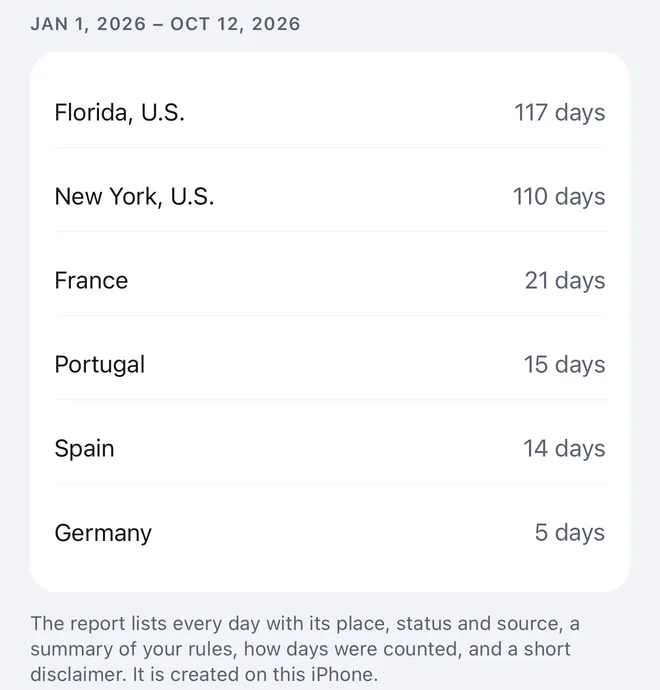
The IRS doesn't take your word for 330 days. Keep what shows where you slept each night: a day-by-day log, passport stamps, boarding passes and e-tickets, and leases or hotel bills abroad. Passport stamps alone miss days, because moving between Schengen countries usually leaves no stamp. A log kept as you go is stronger than one rebuilt from memory: see how Daysafe records each day.
Leaving a U.S. state for good? Its rules don't stop at the border. New York, for example, still taxes a domiciliary abroad unless they meet its own count of 450 days abroad in 548: see New York residency audit.
Physical presence vs. bona fide residence
The other route has its own guide: bona fide residence test, with Form 2555 Part II line by line. Traveling full-time? See digital nomad taxes for the tax home test and self-employment tax.
| Physical presence test | Bona fide residence test | |
|---|---|---|
| What counts | 330 full days abroad in any 12 months | Being a resident of a foreign country for an uninterrupted period that includes a full tax year |
| Based on | Days only | Facts and circumstances: intent, home, ties, foreign taxes |
| Trips to the U.S. | Each one uses up your 35-day budget | Brief trips are fine if you clearly intend to return |
| Good for | Nomads and people who move around | People settled in one country |
Questions
Do the 330 days have to be consecutive?
No. Any 330 full days within the 12-month period count, with trips in between.
How many days can I spend in the U.S. and still qualify?
About 35 days in a 365-day period, including the days you travel in and out of the U.S. The calculator shows how many you have left.
Does the day I land abroad count?
Only if you spent the whole day there. If you fly overnight and land in the morning, part of that day was over international waters, so it isn't a full day. The IRS gives this example: you arrive in France at 9:00 a.m. on June 11, and your first full day there is June 12.
Does the 12-month period have to be the calendar year?
No. It can start on any day and ends the day before the same date 12 months later.
What if I had to leave a country because of war or unrest?
The IRS can waive the 330-day minimum for countries it lists each year, if you could otherwise have met the test. Check the current IRS list.
Is this tax advice?
No. It counts days. The exclusion has other conditions, such as a tax home abroad — ask a U.S. expat tax professional about your return.
Let your iPhone count your full days abroad
Daysafe records which country you're in each day and keeps your FEIE count up to date — full days only, with the date you'd reach 330. No account; your days stay on your phone.
Get Daysafe on the App Store · Substantial presence test calculator
Sources
IRS, Foreign earned income exclusion — physical presence test; bona fide residence test; Form 2555; Instructions for Form 2555 (2026 amount, line 16, Form 2350). Checked on 13 October 2026; exclusion, Form 2555 and Form 2350 rechecked on 25 November 2026. Daysafe is a day counter, not tax advice. Made by Denis Chudinov.