 Daysafe
Can You Be a Resident of Two States?
Yes, for state income tax. You can have only one domicile, but a second state can also treat you as a resident under its statutory residency test. In most states that test means more than 183 days there plus a home you keep there; New York's tax department counts 184 days or more, and any part of a day is a day. When both tests hit, both states can tax all your income.
Count your days first: 183-day rule calculator — free, in your browser.
One domicile, but more than one residency
States use two separate tests, and you can fail them in two different states at the same time.
| Domicile | Statutory residency | |
|---|---|---|
| What it is | Your permanent home: the place you intend to return to | A day count plus a home you keep in the state |
| How many you can have | One at a time | Any state whose test you meet |
| How it's decided | Facts and intent: where you live, vote, work, keep your family and things | Arithmetic: days in the state over the tax year |
| Typical threshold | None | More than 183 days (some states use 200, 185 or "more than half the year") |
| What it costs you | The state can tax all your income | The state can also tax all your income |
So the common case looks like this: you are domiciled in Florida, but you keep an apartment in New York and spend 190 days there. Florida is your domicile, and New York treats you as a statutory resident too. Tax advisers call this dual residency. Pennsylvania's regulation says it plainly: an individual "may be a resident of this Commonwealth and taxable as a resident even though he would not be deemed a resident for other purposes." Rhode Island even has a name for it — "double residence."
How the 183-day test works
Most statutory residency rules have the same two parts. You must keep a permanent place of abode in the state, and you must spend more than 183 days there during the tax year. Meet only one part and the test doesn't apply. The days don't need to be in a row: states add up every day you spent there during the year. Don't mix it up with the federal substantial presence test: it also uses 183 days, but it decides whether a non-citizen is a U.S. tax resident and adds up three years with weights.
"More than 183" means day 184
The wording matters. "More than 183 days" is met on the 184th day, which is why New York's Department of Taxation and Finance writes the rule as "184 days or more." How New York checks the count is covered in New York residency audit. Maryland is stricter on paper: "183 days or more," plus a place of abode kept for more than 6 months of the year. If your count is close, read your state's exact sentence before you plan a trip.
Any part of a day counts
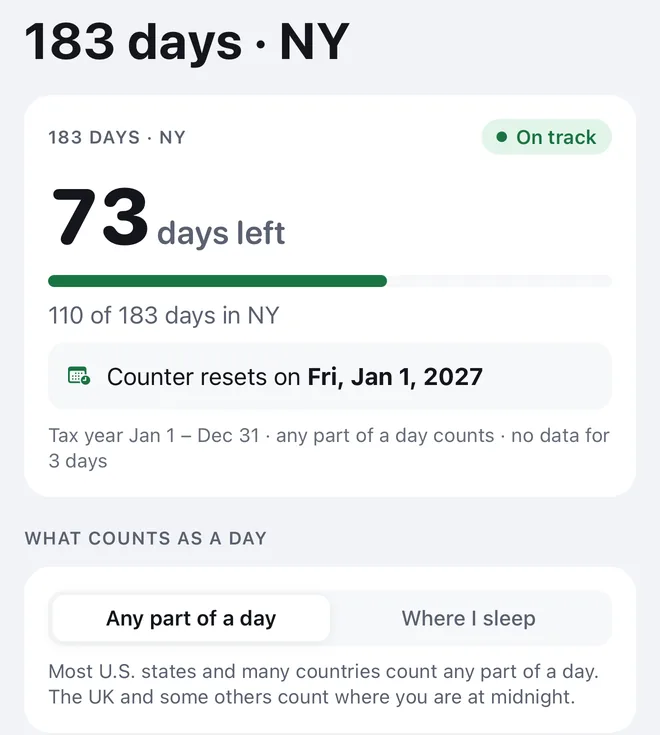
For New York, "any part of a day is a day for this purpose." Minnesota's statute says presence "for any part of a calendar day constitutes a day spent in the state," and Rhode Island's rules say the same. Landing in Newark at 11 p.m. and driving straight into Manhattan is a New York day. Some states carve out transit: Rhode Island doesn't count days spent in the state only while traveling through it. If your state is silent, count every day you were there, even for an hour. To see where you stand, add up your days in the 183-day rule calculator.
State-by-state thresholds
Each state writes its own test. These are the day counts in the statute or regulation for people who are not domiciled in the state. "Home" means the state also requires a permanent place of abode there.
| State | Day count | Home in the state needed? | Source |
|---|---|---|---|
| New York | 184 days or more (any part of a day counts) | Yes, for substantially all of the year | NY DTF |
| New Jersey | More than 183 days | Yes, a permanent home | NJ Division of Taxation |
| Connecticut | More than 183 days | Yes, for the entire year | CT DRS |
| Pennsylvania | More than 183 days | Yes | 61 Pa. Code §101.1 |
| Rhode Island | More than 183 days (any part of a day, except transit) | Yes | 280-RICR-20-55-3 |
| Delaware | More than 183 days | Yes | 30 Del. C. §1103 |
| Maine | More than 183 days | Yes | 36 M.R.S. §5102 |
| Missouri | More than 183 days | Yes | RSMo 143.101 |
| Kentucky | More than 183 days | Yes | KRS 141.010 |
| Virginia | More than 183 days of keeping a place of abode in Virginia | Yes — the count is of days you kept it | Va. Code §58.1-302 |
| Maryland | 183 days or more | Yes, for more than 6 months | COMAR 03.04.02.01 |
| Minnesota | More than half the tax year | Yes | Minn. Stat. §290.01 |
| New Mexico | 185 days of physical presence, whatever your domicile | No | 3.3.1 NMAC |
| Hawaii | More than 200 days: presumed resident (can be rebutted) | No | HAR §18-235-1-07 |
| Oregon | More than 200 days, unless the stay is temporary or transitory | Yes | ORS 316.027 |
| California | More than 9 months: presumed resident — but no day count protects you | No | 18 CCR §17016 |
Checked against each source on 25 November 2026. States not listed either have no day-count test, have no personal income tax, or weren't checked yet — look up your state's own rule.
States where days alone don't decide
A low day count isn't a safe harbor everywhere. California's regulation says a person "may be a resident even though not in the State during any portion of the year": what matters is whether you are there for more than a "temporary or transitory purpose." Leaving California has its own traps, covered in California exit tax. Hawaii's 200-day rule is only a presumption you can rebut with evidence. And states without a personal income tax, such as Florida and Texas, have no reason to count your days at all — the count that matters is the one in the state you left.
What happens when two states claim you
If your domicile state and a statutory residency state both treat you as a resident, each can tax your full income for the year. The usual relief is a credit for tax paid to the other state, and the rules for it differ from state to state. Rhode Island, for example, allows its double-resident credit only "if the other state also allows a similar reduction." The practical result: being a resident of two states can cost real money even with credits, so the cheapest fix is staying under the day count.
How states decide your domicile
Domicile has no number. Auditors look at where your life is centered. Expect questions about:
- Homes: which one you own or rent, how big it is, and which one you live in most of the year.
- Paperwork: driver's license, car registration, voter registration, and the address on your federal return.
- Work and business: where you actually work, not only where your employer is.
- Family and things: where your spouse and children live, and where you keep the items you care about.
- Time: where you spend most of your days — so the day count matters for domicile too.
Moving your domicile is a change of all of these, not a single form. A sworn declaration helps as evidence, but it doesn't outweigh the rest.
Snowbirds: Florida domicile and the count back home
Florida law has no day-count test for residency, and Florida has no personal income tax. Florida lets you put your move on record: under Florida Statutes §222.17 you can file a sworn Declaration of Domicile with the clerk of the circuit court in your county (the full list of steps is in how to become a Florida resident). That's evidence of domicile, not a shield. If you keep your house or apartment up north, your old state's statutory residency test still runs. A New Yorker who keeps a Manhattan apartment and spends 184 days in New York is a New York resident for that year, Florida domicile or not. Count your northern days, and keep the count under the line with a margin for travel days. Canadian snowbirds have a second count to watch, the U.S. federal one: see how long a Canadian can stay in the US.
How to prove where you were
In a residency audit you'll be asked to show where you were. Rhode Island's regulation, for one, says a nonresident with a home in the state "shall have records available for examination" to show they spent 183 days or less there. Records auditors commonly ask for:
- a day-by-day log of which state you were in;
- credit card and bank statements with dates and places;
- phone records, toll and travel records, boarding passes;
- calendars, medical and gym visits, utility bills for each home.
A log written at the end of the year from memory is weak evidence. A log kept as you go, backed by statements, is strong. That's the gap a day counter fills: see how Daysafe records each day.
Example: a New York apartment and a Florida winter
Ana is domiciled in Florida and keeps an apartment in Brooklyn. She spends January to April in Florida, then the warm months in New York, with weekend trips in between.
- By late October she has 183 New York days — still a nonresident of New York under the statutory test.
- One more day in New York — even a few hours — makes it 184, and New York can tax all of her income for the year.
- The day she flies to Florida counts as a New York day, and so does the day she flies back. Two trips can use up four days.
If Ana gave up the Brooklyn apartment, the 183-day count wouldn't apply to her at all; without a permanent place of abode, New York's statutory test isn't met.
Questions
Can you have two domiciles at once?
No. You have exactly one domicile at a time. What you can have is a domicile in one state and statutory residency in another, if you keep a home there and pass its day count — usually more than 183 days.
Is the 183-day rule the same in every state?
No. Many states use more than 183 days plus a home, but Hawaii and Oregon use 200 days, New Mexico uses 185, Maryland uses 183 or more, and California has no protective day count at all. Check your state's statute.
Does a partial day count as a full day?
In New York, Minnesota and Rhode Island, yes: any part of a day in the state is a day, so travel days count. Rhode Island excludes days spent only passing through. When a state doesn't say, count every day you were there.
Can I be a resident of two states without owning a home?
Most statutory residency tests need a permanent place of abode, which can be rented. Without one, those tests don't apply. New Mexico and Hawaii are exceptions: they look at days only.
What if I moved to another state during the year?
Then you are usually a part-year resident of each state: a resident of the old one until the move and of the new one after it. New Jersey notes that some people must file both a part-year resident and a nonresident return. Keep the moving date and your days on each side.
Do I have to file tax returns in both states?
If both states treat you as a resident, expect to file a resident return in each and claim any credit the rules allow. Ask a tax adviser in both states before you file.
Is this legal or tax advice?
No. Daysafe counts days and shows the rule text with its source. For your situation, talk to a tax adviser who works with multi-state residency.
Keep the day count that auditors ask for
Daysafe records which U.S. state you're in each day, counts any part of a day, and warns you before a state's limit. Add a rule for New York, New Jersey or any state, then export a day-by-day PDF or CSV for your tax adviser. No account; your days stay on your phone.
Get Daysafe on the App Store · 183-day rule calculator · Canadian snowbirds in the US
Sources
New York State Department of Taxation and Finance, Residency definitions; California Code of Regulations, Title 18, §17016; Pennsylvania Code, 61 Pa. Code §101.1; Rhode Island Division of Taxation, 280-RICR-20-55-3; Hawaii Administrative Rules §18-235-1-07; Oregon ORS 316.027; Minnesota Statutes §290.01; New Jersey Division of Taxation, Residency status; Connecticut DRS, Resident income tax; Code of Virginia §58.1-302; New Mexico 3.3.1 NMAC; Maryland COMAR 03.04.02.01; Maine, Missouri, Delaware and Kentucky statutes linked in the table; Florida Statutes §222.17 and Constitution, Art. VII §5. Checked on 25 November 2026. Daysafe is a day counter, not legal or tax advice. Made by Denis Chudinov.